
What Probate Covers in Coal County
Probate is the court process for handling estates, wills, and the legal care of people who cannot act for themselves. In Coal County it reaches estate administration after a death, the proving of wills, guardianships for minors and incapacitated adults, conservatorships over property, and trust proceedings. Each of these is a recognized case type in the Oklahoma court system.
Coal County does not have a separate probate court in the available official sources. Probate is the probate division of the District Court, and the files are recorded and kept by the Coal County Court Clerk. The same clerk who handles civil, criminal, family, and small claims matters also works with the probate division, so one office is the local point of contact for estate and guardianship records.
That structure matters when you start a search. You are not looking for a standalone probate court address. You are looking inside the district court records for Coal County, then reaching the Court Clerk for anything the online docket does not show.
Probate also overlaps with other record types people often confuse with it. Estate disputes can spill into civil filings, guardianship can touch family matters, and a will can affect land titles recorded with a separate county office. The probate case itself, though, stays in the district court under the Court Clerk, and that is where the core estate and guardianship file lives.
Probate Terms Defined
Probate files use words that rarely come up anywhere else, and the meaning of a case can hinge on them. The short glossary below covers the terms you will meet most often in a Coal County estate or guardianship file.
- Testator
- The person who made the will.
- Executor
- The person named in a will to carry out its terms and settle the estate.
- Administrator
- The person the court appoints to settle an estate when there is no will or no named executor able to serve.
- Intestate
- Dying without a valid will, which sends the estate through the state's default inheritance rules.
- Guardianship
- A court arrangement giving one person authority to care for a minor or an incapacitated adult.
- Conservatorship
- A court arrangement placing a person's property and finances under the management of another.
A personal representative is the broader term that covers both an executor and an administrator. Reading these labels correctly tells you who has authority over an estate at any point in the case.
How to Search Coal County Probate Records
Probate cases for Coal County appear on the two Oklahoma court portals. The Oklahoma District Court Records system lists Coal as a participating court, and the statewide Oklahoma State Courts Network carries district court dockets. Both let you search by party name or case number and filter by case type.
- Open odcr.com, select the Coal court, and choose a type of case such as Probate, Probate Miscellaneous, Filing of Wills, Guardianships, Conservatorship, or Trust Proceedings.
- Open oscn.net, choose Coal County District Court, then search by party name, case number, or a probate case type including Filing of Wills and Trusts.
- For estate files that are not online or for older records, call the Coal County Court Clerk at 580-927-2281.
- For certified copies of orders, letters, or a will admitted to probate, send your request to the Court Clerk.
Online dockets are a starting point, not the full file. Documents may be limited or paywalled, and some estate papers exist only at the courthouse counter, so the clerk remains the source for the complete record.
What Coal County Probate Records Show
A probate file builds a paper trail from the opening petition through the closing decree. The docket names the parties, lists each filing, and tracks the hearings that move the estate or guardianship forward. Case numbers carry probate prefixes such as PB or PROB, and related labels may appear depending on the system.
The parties in a probate case can include the deceased, the petitioner, the personal representative, an executor or administrator, a guardian, a ward, heirs, interested parties, and the attorneys involved. The filings build the substance of the file, and the most common ones are listed below.
- Petition or application that opens the case.
- The will, where one was filed, and any death certificate reference.
- Notices, proof of publication, and proof of service.
- Inventory and appraisement of estate property.
- Accountings, creditor claims, and orders.
- Letters testamentary or letters of administration.
- The final decree closing the estate.
Hearings recorded in the docket can include the appointment of a representative, the probate of a will, guardianship review, accounting approval, confirmation of a sale, and final distribution. Reading those events in order shows exactly where a case stands.
Probate Filing Fees
Coal County does not publish a probate filing-fee table in the official sources reviewed for this page. The county fees page points to the Oklahoma State Courts Network for clerk fee and bond schedules rather than listing probate amounts directly. Because no county-specific probate figures were located, the table below marks each item for confirmation instead of stating a number that could be wrong.
| Item | Amount |
|---|---|
| Original probate application | Not listed in Coal County sources; confirm with the Court Clerk |
| Letters testamentary or administration | Not listed in Coal County sources; confirm with the Court Clerk |
| Guardianship or conservatorship application | Not listed in Coal County sources; confirm with the Court Clerk |
| Certified copy of an order or will | Not listed in Coal County sources; confirm with the Court Clerk |
The county land-recording fees kept by the County Clerk are a different schedule and do not apply to probate case filings. For the current probate charges, ask the Court Clerk or check the linked state fee and bond schedules.
Where to File and Request Probate Records
Probate cases are filed with the Coal County Court Clerk and heard in the District Court. That office is the place to open an estate, file a will, request a certified copy, or ask whether a case is on record. The contact card below has the details for the clerk who keeps these files.
Coal County Court Clerk
LaDonna Flowers, Court Clerk
4 N Main Street
Coalgate, OK 74538
580-927-2281
Hours: 8:00 to 4:00
Guardianship and some estate matters can involve a person who cannot afford a lawyer. In those situations, court-appointed counsel may come through the state. The Oklahoma Indigent Defense System explains its role for indigent representation in Oklahoma counties.
Background on that office sits at oklahoma.gov/oids, which describes how state-funded defense works outside the largest metro counties.
For most probate questions, though, the Court Clerk is the first call. The clerk can confirm a case number, explain what is on file, and outline how to request certified documents.
Small Estate Affidavit Caveats
Oklahoma law offers a smaller path for some estates. References in the state statutes point to Title 58 Section 393, which allows certain personal property to pass by affidavit instead of a full probate case, generally for estates under a set value. This can save time when an estate is modest and holds no real property.
Coal County probate forms for this process were not located in the official sources, so no county-specific affidavit or fee is presented here. Real property usually pushes an estate back into full probate, and the rules carry conditions that are easy to misjudge. Confirm with the Court Clerk or an attorney before assuming an affidavit replaces probate.
A full probate case opens with a petition, moves through the appointment of a personal representative, and closes only after notice to creditors, an inventory, and a final accounting. A small-estate affidavit skips much of that process, which is why the value limit and the no-real-property condition matter so much. When an estate is close to the threshold or holds mixed assets, a short call to the clerk can tell you whether the shorter path is even open.
Restricted Probate Details
Most probate dockets are open to the public, but parts of a file can be shielded. Guardianship cases often involve medical and financial details that are sensitive by nature. Information about minors, sealed exhibits, and confidential identifiers may be restricted or redacted even when the rest of the case is public.
Related confidentiality rules show why some family-court material is closed. Oklahoma treats adoption records as confidential except by good cause and court order, and that standard is published in the state administrative rule at law.cornell.edu.
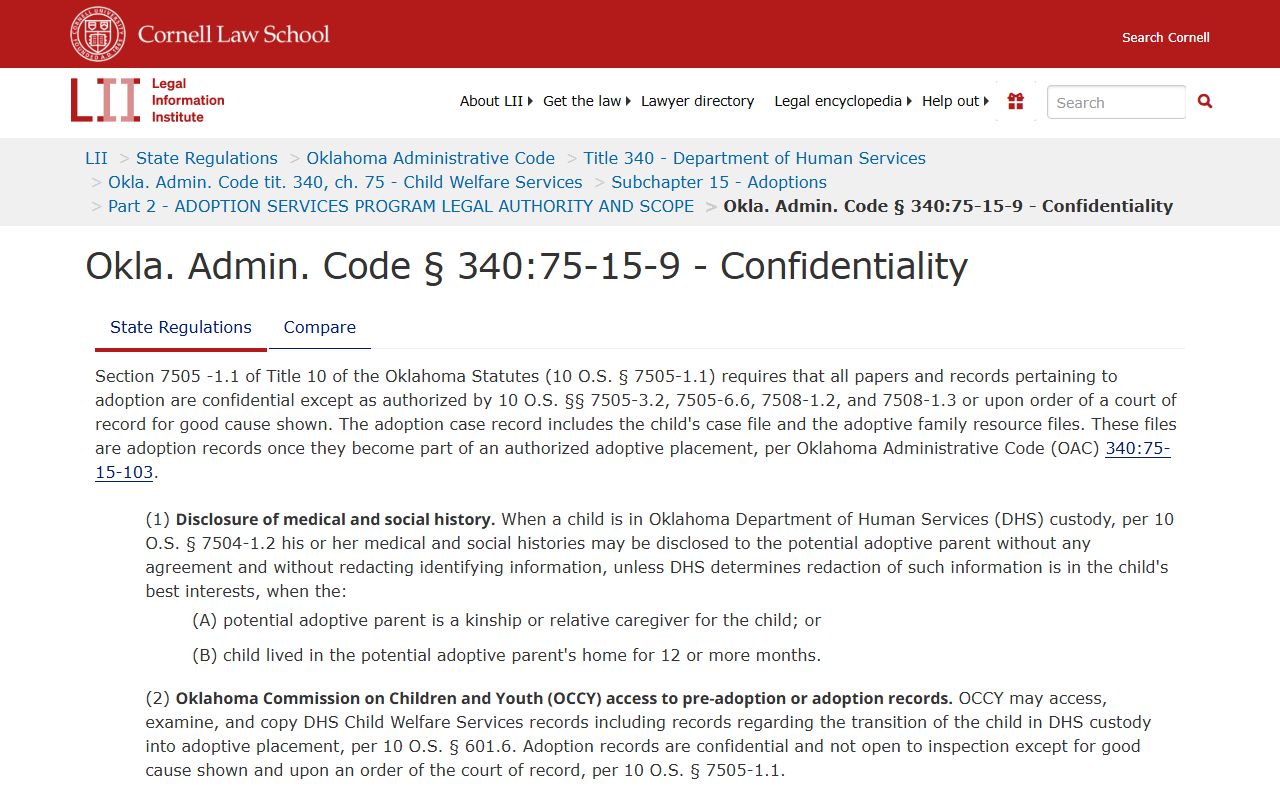
That rule helps explain why courts close certain records tied to children and families. When a probate or related file is partly sealed, the public docket may confirm an item exists without revealing its contents, and the same Court Clerk who keeps Coal County marriage and divorce records can explain what access the law allows.